Mystery Stole 3: A Quick Question

I haven’t written about Mystery Stole 3 in a bit. That’s because I’ve gone into teacher mode, which can seriously compromise my ability to work complex patterns. When I get home from work after 6:00 or so, all I’m interested in is dishrags, dishrags, dishrags. Quick, bright, varied, easy-to-try-something-new-on dishrags. Or maybe a washcloth for a change of pace.

I have nonetheless been faithfully downloading the patterns for MS3 and trying to track a few of the overwhelming thousands of posts about it. The design is coming out asymmetrical, with one end pointed and the other finishing in a graceful curve. To achieve this, the pattern switches from back-and-forth knitting to knitting on the diagonal, picking up stitches as one progresses.

To be frank—I’m intimidated. I have no trouble picking up stitches to add a button band or to “piece” a knit along one edge for a patchwork effect (my results are sometimes lovely, sometimes not so lovely, but I’m not intimidated). But the knitting one piece onto another as I go, picking up one stitch per row, that frightens me for some reason.

Based on the pictures I’ve seen by folks who are further along in the pattern than I am (here‘s an example at Tangled String) I’m thinking about opting to knit the first several clues twice and then grafting the identical halves. The wing design is gorgeous, but I really do like the lace pattern of the pointed end better and… no one-stitch-at-a-time pick-up.

So here’s my question. If I decide to go for the double-pointed option (which I really do find prettier, not just less intimidating) am I copping out; is this one of those projects that has something important to teach me and upon which I should refuse to compromise or is it OK to follow my own tastes and inclinations, even if this means skipping part of the challenge? (That’s a long sentence I know, but I was trying to really keep it one question.) I would love to hear from other folks, those who are further along on this pattern than I am and also those who just find themselves with an opinion on this topic, whether or not they’re part of the MS3 undertaking.

The Testimony of Our Hands

Mmmmmm. Before we do anything else, check out this yarn.
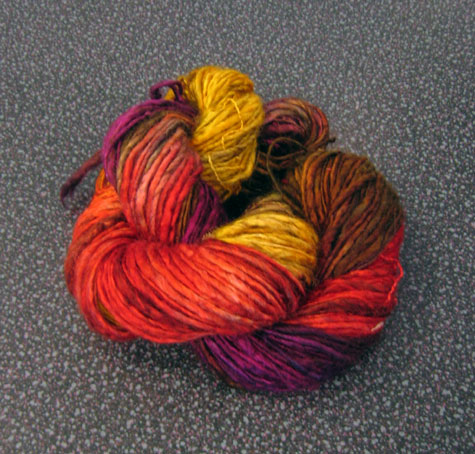
Prize yarn
It’s from Cathy-Cate at Hither and Yarn. I won this prize for being the 100th commenter on her blog. I had no idea there was even a competition going on! She sent me the nicest note, congratulating me and asking about my taste in yarn. I told her I like rich colors, and she wrote back to say, “I have just the thing.” Well, this yarn most definitely is just the thing. It’s a 140-yard skein of wool-silk blend with a real sheen to it (the photo gets the colors right, but doesn’t reproduce its luster). I don’t know yet what I’m going to make with it, but this skein definitely deserves to have a new pattern written it its honor—perhaps some decorative, but functional wrist warmers?

As I promised, here’s a picture of the dishrags I knit up using self-striping Sugar ‘n Cream.
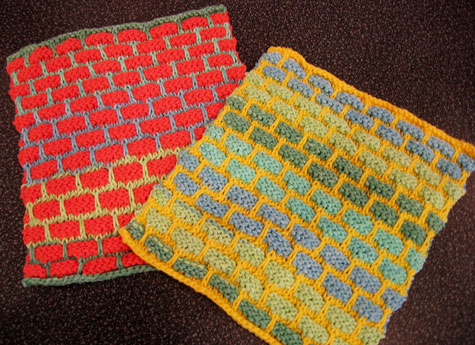
Self-striping dishrags
The cloth on the left uses the self-striping yarn as the background; the cloth on the right uses it as the “ribbons” that run across the piece.

Melissa and I spend most weekends together, but occasionally life interferes, as is the case this weekend. She needs to spend most of her time up in Oakland carving lino-blocks for her upcoming shows; I need to stay in Santa Cruz to protect the homestead from ravening herds of raccoons. So, in lieu of a weekend’s domestic bliss, we met up in San Jose for a date.
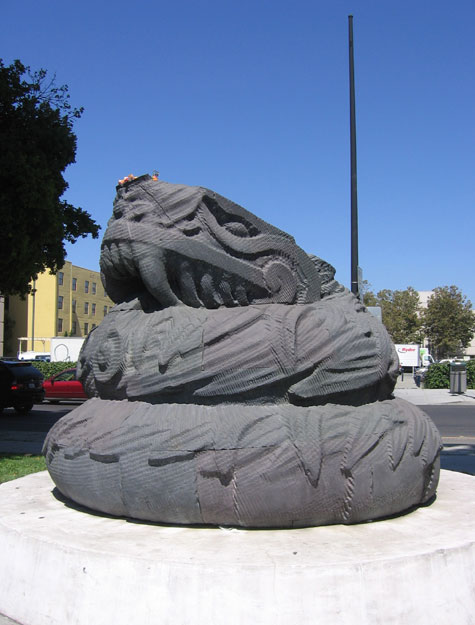
The feathered serpent of San Jose
We both love this statue of the feathered serpent, Quetzalcoatl, that stands guard at the plaza set among the city’s museums and theaters.

After a delightful lunch at the Old Spaghetti Factory (bless Melissa for her willingness to indulge my love of mizithra!), we walked to the San Jose Museum of Art, which is hosting an exhibit of the works of Martín Ramírez.
Museum wall sign for the Martin Ramirez exhibit

The museum documentation offers a brief summary of his life story:

Ramírez (1895–1963) created some three hundred artworks of remarkable visual clarity and expressive power within the confines of DeWitt State Hospital, in Auburn, California, where he resided for the last fifteen years of his life. He had left his native Mexico in 1925 with the aim of finding work in the United States and supporting his family back home in Jalisco, but the economic consequences of the Great Depression left him homeless in northern California in 1931. Unable to communicate in English and apparently confused, he was diagnosed as a schizophrenic and spent the second half of his life in mental institutions.

In the 32 years he was institutionalized, Ramírez hardly spoke to anyone but taught himself to draw. Tarmo Pasto, a professor of psychology and art at Sacramento State University, discovered Ramírez’s drawings in the early 1950s. Pasto started to supply Ramírez with materials and eventually collected his drawings and organized public exhibitions of his work.

Martín Ramírez’ oeuvre forms an impressive map of a life shaped by immigration, poverty, institutionalization, and most of all art. Migration and memory seem to factor strongly in his images, which document his life experiences; favored images of Mexican Madonnas, animals, cowboys, trains, and landscapes merge with scenes of American culture. While his singularly identifiable figures, forms, line, and palette reveal an exacting and highly defined vocabulary, they also show Ramírez to be an adventurous artist, exhibiting remarkably creative explorations through endless variations on his themes.

The mix of beauty and playfulness in this piece drew an involuntary little gasp from me as I turned to face it.
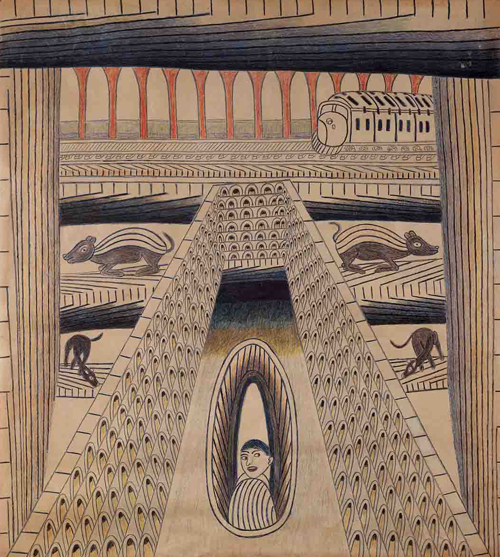
Martinez drawing: Courtyard

As you can see in this image, his works are quite large and done on multiple sheets of paper pasted or taped together.
Martinez drawing: Madonna
Melissa and I wondered whether this was by choice or if he was only supplied with the small sheets and did the joining up out of necessity. We also wondered whether he drew first, then joined or vice versa. Because he was viewed as an interesting psychological case, rather than as a full-fledged artist, during his life, his artistic process seems not to be well documented.

One of the most enjoyable features of the San Jose Museum of Art is the reading area attached to each exhibit, with comfy chairs and books about the featured artist and related works. We looked through the exhibit catalogue and decided we’d have to buy a copy of it. We also fell in love with another book, Miracles on the Border: Retablos of Mexican Migrants to the United States. Unfortunately, the museum didn’t have this book for sale, but we’ll be tracking down a copy as soon as we can.

We made our second stop at the San Jose Museum of Quilts and Textiles, which currently offers several exhibits of textiles exploring themes of war and human rights.
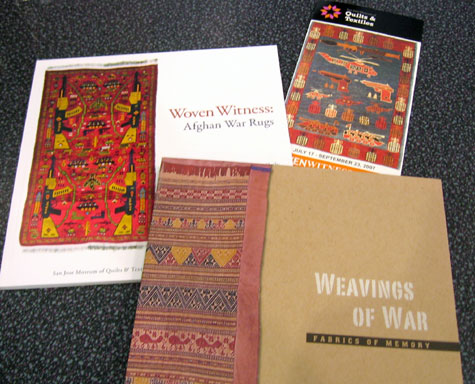
Literature from the Quilt and Textile Museum

“Woven Witness: Afghan War Rugs and Afghan Freedom Quilt” looks at the way traditional Afghani rug making has been altered to incorporate images of military conflict.
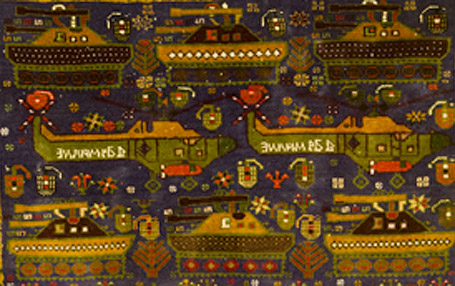
Detail of Afghan war rug
These images began to appear in Afghan rugs, at first in “hidden” form, shortly after the Soviet Invasion in 1979 and continue to appear—modified to reflect changing politics and conflicts—today.

The traveling exhibit, “Weavings of War: Fabrics of memory,” includes pieces from many cultures.
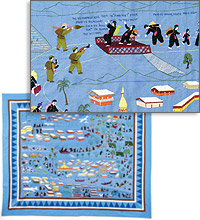
Hmong story cloth
This Hmong story cloth documents Hmong collaboration with U.S. forces in Vietnam, their subsequent persecution, escape as refuges, and immigration to the U.S. The exhibit also included two large quilts and several smaller pieces documenting life under apartheid in South Africa, small works in appliqué from Chile and Peru documenting human rights abuses, and traditional Asian weavings with military motifs incorporated, along with a number of other kinds of pieces.

I feel insufficiently wise to explain what viewing these pieces meant, the messages they spoke, and the ways they made me contemplate what it means to be an American living the life that I do. The scope of the violence and suffering is so broad and has so many causes that I could easily feel helpless in the face of it all. But these pieces of handwork remind me of the power of individual actions. Perhaps one of the lessons is that I shouldn’t waste my time trying to decide upon the most effective, most comprehensive action. Instead, I should focus right now on the things I do every day, the activities I love, and work to make them part of my own response to the injustices around me.

Scenic Oregon, Part II

When Melissa and I made our trek to Oregon, we took Interstate 5 North, then cut west to the coast highway for the drive home. We’d already been talking about retiring to western Oregon when the time comes, now we’re absolutely set on it. Here are a few of our favorite sights—photos by Melissa.

Once we hit the coast, we did a little jog north to Seaside.
The beach at Seaside

Our first night driving home, we pitched our tent at Devil’s Lake campground.
The campground at Devil Lake

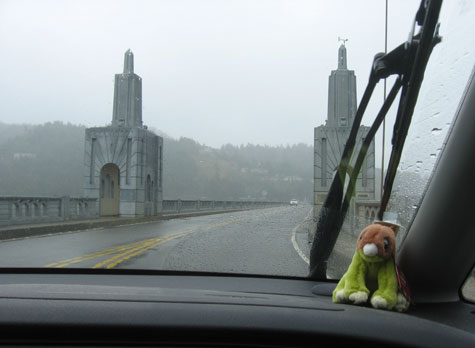
The coastal bridges in Oregon are wonderful, solidly constructed of steel and concrete, but with crenellations and turrets that set each one apart and speak of a time when beauty wasn’t sacrificed to efficiency.
One of many lovely Oregon bridges

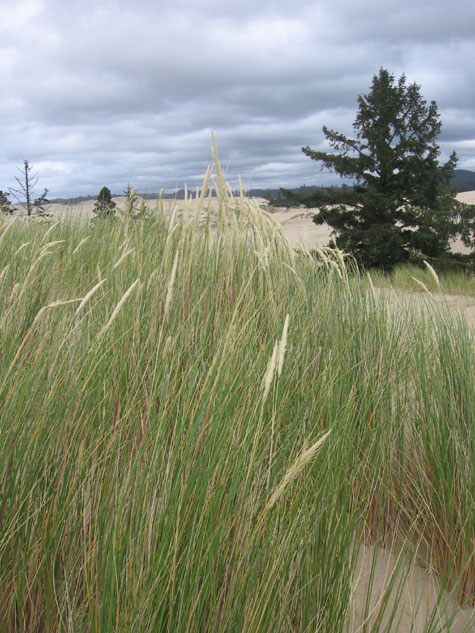
The dunes were breath-taking, but not where we’ll retire. Melissa took these two photos in a protected area. A few hundred yards to the south, the dunes were given over to all sorts of roaring, grinding all-terrain vehicles that had obliterated the beach grass and wildflowers.
Oregon dunes

Oregon dunes

The roadsides were thick with flowers, including a favorite of mine—thistles.
Thistles growing along the coast

If we could pick any of the spots we stopped at for our future home, we would choose Port Orford. We stayed in a small motel, just across the road from this beach and managed to squeeze in a walk before the rain really started pounding.
Battle Rock, Port Orford

Port Orford is the furthest point west in Oregon, so if it’s going to rain anywhere in the state, it will rain there.
The foggy, rocky beach at Port Orford

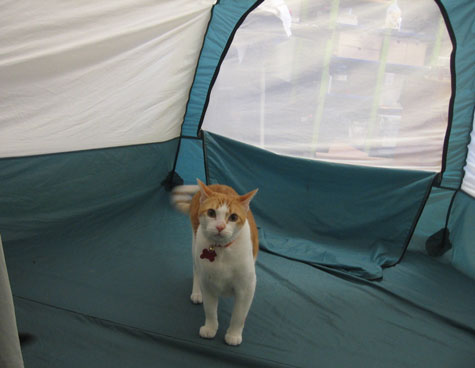
When we got home, our tent was still drippy from the rain we had at Devil’s Lake, so Melissa set it up inside to dry out. Damian quickly nominated himself Chief Tent Inspector.
Tent inspection upon our return
Lucky for us, he seemed to find everything in order.

Uninvited Guests

Go here. Read some columns. Read a few more. Laugh. Read the piece for today and think of me.

Like Jon Carroll, I am dealing with raccoons. Dealing with raccoons is like scrubbing the toilet. You do it, you think you’re home free, then you start getting those tell-tale signs that you’re going to have to do it all over again. In fact, as Carroll points out, dealing with raccoons has a cause-effect correlation with scrubbing the toilet.

My cats expect twenty-four/seven, indoor/outdoor access. Now, if I lived in a bigger home, perhaps for their safety and my peace of mind I could fight them on this. But I live in a loft-like, two-level home that has no interior doors (except for the bathroom). I cannot shut the bedroom door and leave the unhappy cats on the other side of it to complain out of earshot about my trampling on their individual liberties and their burgeoning sense of claustrophobia. If the cats aren’t happy, I have nowhere to hide from them.

Each cat has a particular I-want-to-go-out-now-and-I-don’t-care-what-hour-it-is routine.

Bea’s technique goes like this:
1. Climb onto the dresser.
2. Jump from the dresser onto the bed.
3. Jump off the bed.
4. Dash downstairs, then check if the staff (aka me) is following to open the front door.
5. If the desired result is not achieved, repeat steps 1-4 as necessary.

Here’s Sparky’s variation:
1. Chirp.
2. Chirp some more.
3. Keep chirping.
4. While chirping, knock something off the dresser.
5. If the desired result is not achieved, repeat step 4 as necessary, moving to progressively larger items.

So I’ve set things up to let the cats come and go as they please.

Unfortunately, raccoons are about the same size as cats and probably even more intelligent. So we have a few happy weeks during which Bea and Sparky come and go as they please and I get some uninterrupted REM sleep.

Then the raccoons (re)discover my home. “Look! The ‘in’ is open!,” they chatter to one another, after which they race upstairs and start chomping down kibble as fast as they can. At some point the prolonged crunching drags me from my sleep—the only way Bea or Sparky would be eating that much is if they’d received puncture wounds in their little bellies and the food was falling straight out again.

I turn on the light. The raccoons shout “Cheeze it!” and run willy-nilly for the escape hatch. I wait a few moments to allow them a graceful exit, then close up the cat access as Bea and Sparky come out of hiding and sniff at raccoonly traces that I am too uncivilized to appreciate.

Sometimes Bea and Sparky are traumatized enough that they don’t even bug me about the twenty-four/seven, indoor/outdoor thing for a day or two. But then the raccoons fade from memory and we’re back to our two sets of steps 1-5 as outlined above.

If I’m really lucky, those few days of limited access get the raccoons to cross me off their route, but then access is restored and sooner or later the raccoons figure out that I’m back in business and—whee!—we’re at it again.

Right now, we’re at one of those points where the raccoons have rediscovered the all-night kibble palace that is my home and Bea and Sparky are refusing to give up on 1-5. Maybe it’s time to try shutting the one door I do have and sleeping in the tub.

P.S. The Mason-Dixon washrag with self-striping yarn? Gorgeous! Pics soon.

Buzzing Back to the Hive

Academic jobs (and many others, I suppose) tend to be pieced together out of a variety of activities/obligations. Right now, I’m juggling three chunks of work: my Shakespeare class, a textbook review for a publishing house, and mastering my “new job”: ELWR (Entry-Level Writing Requirement) Coordinator at UC Santa Cruz. You may remember my entry from May when I talked about the joys of UC’s statewide writing placement test and the process of reading thousands of student essays (two to three times each) over the course of a single weekend. Well, I’m now in charge of that exam on my campus and all the record-keeping and detail-tracking-down that entails. I will coordinate four yearly administrations of the exam here, organize two major readings of student portfolios, track all the pass/no-pass data, make sure student records are accurate, and do anything else related to the placement exam that falls into my lap—returning calls from worried students and fretting parents, projecting class enrollments, and the like. This job requires a very detailed calendar and a gazillion to-do lists. I’m approaching it with the idea that if I do 3-6 little tasks for it pretty much every day, then I won’t get buried alive. I desperately hope I am right about this.

Today I sorted through several hundred electronic files bequeathed to me by the former ELWR Coordinator. I didn’t read them all, but I created my own on-line filing system for them in hopes that I’ll be able to find the data I need as questions arise. I also did my first-ever work creating/adapting excel documents and sent those out to various people.

Having been a dutiful worker bee, I’m now heading home for some knitting, some noshing, and some baseball watching. I’m on number two of the four-of-a-kind pattern-writing project. I’m also back to playing with dishcloths. Did you know that Lily’s Sugar & Cream comes in self-striping colorways? I didn’t—at least not until I came across this yarn at Michaels over the weekend. On an eight-inch dishcloth the stripes come out one-to-two inches wide (wider than the pictures on Lily’s web site make them appear). I can’t wait to try combining one of these yarns with a solid color for a Mason-Dixon style dishcloth.

By the way, if you’re a reader of fiction, check out Tracy Chevalier’s Burning Bright. To sum it up in a sentence, Burning Bright relates a year in the life of two children who are neighbors of the poet/artist/philosopher/printer William Blake (1757-1827), but that description doesn’t begin to do it justice. This book is a wonderful mix of opposites: simple on the surface, but complex in the topics it deals with; both a story of childhood and an exploration of English politics at the time of the French Revolution. It reads easily, but stays with you, leaving you to ponder all sorts of interesting questions.

Tuesday Mewsday: Maggie Gets Her Woozle On

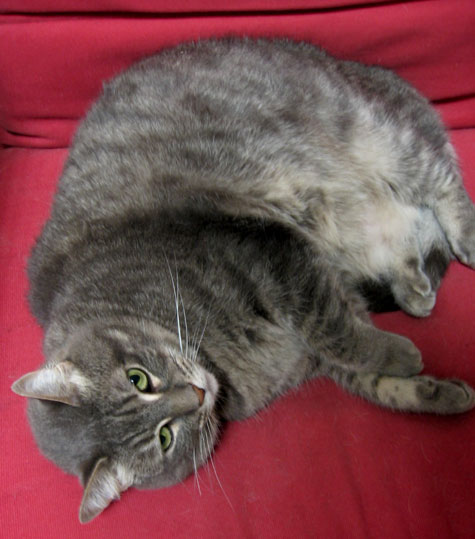
Melissa’s cat Maggie has an unusual build: long, supple back, shortish legs and tail. She also has a tendency to roll her eyes heavenward.

In her younger days, her woozling and eye rolling made her quite the coquette, as you can see in this portrait by Melissa.
A  portrait of Maggie in her younger, svelter days.

These days, her appearance is more that of the well-indulged concubine.
Maggie on the orange chair.

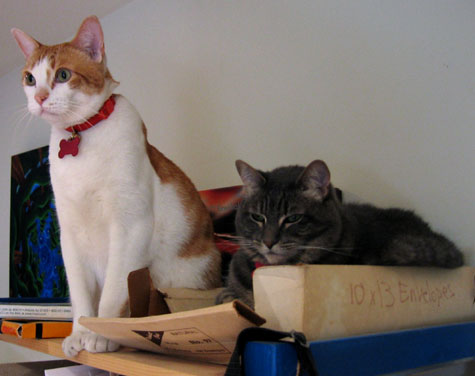
With all the eye-rolling, she sometimes takes on the appearance of a saint in ecstasy. If she could, Maggie would no doubt tell us that she has no choice but to be saintly—how else would she manage the patience to put up with Damian?
Maggie and her nemesis.

Same-Day Turn Around! Go Cotton Commandoes!

I got the Dishrag Tag box today. In the back of my mind, I’d been wondering whether I could manage same-day turn around. I knew that if the box came on a Thursday I couldn’t, because for some reason Thursday mail never arrives before five or six o’clock. But today being a Monday, I picked the box off the front porch at 1:30 and got to work. I admit that the dishrag I knit is merely utilitarian: knit-on-the-diagonal garter stitch. To jazz it up, I switched from variegated to solid yarn at the midway point. Nonetheless, I am deeply chuffed because I got it in the mail at four o’clock! I rock! Cotton Commandoes rock! If only all of us could channel all our competitive energy into dishrag knitting, beating our swords into needles. Imagine a world where international disputes get settled by a knit-off.

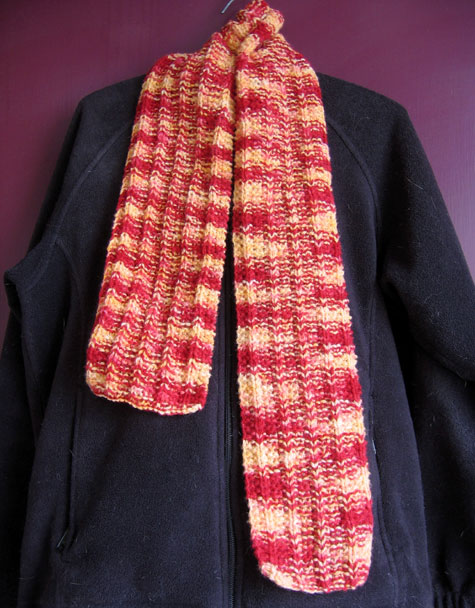
My Phoenix scarf is finished.
Phoenix scarf, finished

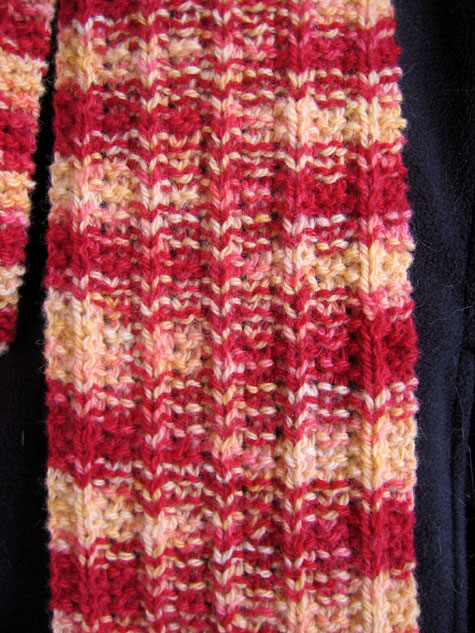
Phoenix scarf, detail
I made up this two-row stitch to try out with this particular skein from Tallgrass Yarns. I wanted a stitch that mixed Ks and Ps for maximum color-blending and that would have a clear vertical line to it.
Cast on 27 stitches (or any multiple of 5 + 2)
Odd rows: *K2, P1, K1 through the back loop, P1* repeat across, ending with K2
Even rows: *K2, P3* repeat across ending with K2
That’s all there is to it. My version used one 240-yard skein of worsted-weight yarn.

And now I must turn back into my everyday, non-dishrag-knitting self and finish all the work I tossed to one side when the box arrived. I’ve got a three-hour class to teach tomorrow.

P.S. Kudoes to Chris, who suggested Elann for yarn for Silver Belle. I’m looking at two of their aran-weight yarns. One is 80% wool/20% alpaca; the other is 50% wool/50% llama. Has anyone had experience working with either of these? How do they feel next to the skin?

P.P.S. Not only did Laurie send me a great dishrag in the Dishrag Tag box (a pretty yellow/white ombre), she also sent four lovely stitch markers and chocolate, the last of which may help explain my knitting speed. What wonderful treats!

Oh Wow, Like This Is a Knitting Blog?

Have you been to Vogue Knitting’s web site and checked out the free patterns from their 25th Anniversary cover series? A great many of them lean toward the shapeless, but I am absolutely in love (don’t worry, Melissa knows, and she’s confident it’s no threat) with Debbie Bliss‘s “Silver Belle.”
A lovely sweater from Vogue.
The construction is fascinating, if a bit daunting. The peplum is knit from the hem up, with cable extensions at each end that wind up just inside the button bands. There’s also a cable extension up the center back. Then each sleeve/body side is knit from the wrist inward and they’re joined to the peplum, after which come the button bands.

I spent a bit of time yesterday trolling about the discount yarn sites (Little Knits, Webs, KnitPicks) looking for some bright moss green (like Oregon) or grey solid-colored alpaca or part-alpaca, but no luck. I want alpaca because that feels good to me, so I know I’ll really wear the sweater once (if?) it’s done; I want discount because this sweater takes about 2,000 yards in my size, so if I make it I’m looking at buying 2+ bags of yarn. If you have any hot tips or suggestions, please let me know.

The weather in Oakland is lovely just now—sunny with a breeze off the bay that keeps things from getting too hot—so Melissa and I headed off to an Oakland A’s game in the afternoon. It was a give-away day, and we each now own a Nick Swisher belt buckle.
Nick Swisher belt buckle.
They are large and very, very shiny and will come in quite handy if either of us decides someday to take up steer wranglin’.

Since I am a knitter and this is a knitting blog, I took my yarn to the game—a one-pound cone of apple-green Peaches ‘n Creme. I tried to get my knitting into this shot taken by the “Game Day” photographer, but didn’t hold it up high enough. Sorry to let our side down.
Enjoying a game at the Coliseum.
By the way, that is an Albuquerque Isotopes hat I’m wearing.

I finished one dish cloth and got most of the way through another, and the A’s won 2-1, despite getting only two hits to Anaheim’s eight.

I kept going on the knitting last night, finishing up my Phoenix scarf (pic and pattern tomorrow) and the first of a set of four variations on a theme for a pattern I’m hoping to find a home for once they’re all done. This afternoon I’m off to a “tasting” of Uruguayan yarns at Article Pract.

Winners!

Our “mystery” road signs have all been accounted for, the Teardrop Flags were a massive success.

Mandie had the first correct answer, idetifying Troutdale as the home of Tad’s Chicken ‘n Dumplins.
Tad's Chicken n Dumplings

Lin came next, placing the Egyptian Theatre in Coos Bay.
Detail of the Egyptian Theater sign

Nicole figured out that Bell Buoy Crabs is in Seaside.
Bell Buoy Crabs

And Lella solved our last mystery, tracking the penguin to his home in Cascade Locks.
Cool sign

Amazingly enough, none of our winners lives in Oregon—in fact, two of them live outside the U.S. Viva Google! Viva winners!

Health care is dear, and sometimes patients cannot order the medicines they need. A review published by The National Institute of Mental Health states that impotence affects 140 million men worldwide. Cialis is an ideal medicament for helping men to sustain an erection. If you’re concerned about sexual disfunction, you have to learn about “Propecia without prescription“. What is the most considerable info you perhaps remember view about this? What researchers talk about cheapest pharmacy for cialis? Several drugstores describe it as cialis price. Remember to diagnose a man’s sexual problem, the physician likely will begin with a thorough history of diagnostic. Not to mention, if you have any other questions about this medicine ask your physician.

Oregon’s Lost World

[Note: There is no knitting content in this post, so feel free to skip it—but be advised that if you do you’ll be missing out on some of the coolest gigantic roadside art ever.]

Who in her right mind would drive past this sign without pulling over?
Turn here for dinosaurs!

The mighty Tyrannosaurus beckons Siren-like and I am helpless, forking over my $7 admission without batting an eye.
The mighty tyrannosaurus, with a brontosaurus hiding in the bushes behind him.
(Check out the man-udder on this guy; Damian would be jealous.)

Prehistoric Gardens is just south of Port Orford on Oregon’s coast. While clearly an amateur effort, these dinosaurs have been sculpted with real love, passion even, and a commitment to scientific integrity. Sculptor E.V. Nelson consulted with academics and did research on his own, trying to assure that these dinosaurs are accurate in terms of size and proportions. He provides context with several large signs outlining the evolution of plant life (that made life on land, and hence dinosaurs, possible) and the geologic epochs in which these creatures lived.

We were lucky enough to visit the gardens on a drippy, misty day, so the setting was perfect for an encounter with these megafauna.
The dinosaurs are everywhere in the Oregon rainforest

We saw Triceratops, both adult…
Triceratops

…and junvenile…
Babies!

…Ankylosaurus…
A rather pensive ankylosaurus

…Elasmosaurus…
This dino has very large and sharp teeth

…the Pterodactyl…
The buff pterodactyl

… and Archelon.
Turtles were bigger back them

We even escaped with a little dinosaur of our own.
We escape with a dinosaur of our own
Melissa found this baby Stegosaurus in the gift shop. I have named her Rowena.

If you, too, have been enchanted by this lost world, you may want to check out the following links:
• A photo collage of the dinosaurs
• Prehistoric Gardens map
• A history of Prehistoric Gardens and its (sadly no longer in operation) “sister” Thunderbeast Park
• A complete set of photos of all the dinosaurs (these photos predate a recent, and more subtle, repainting of the creatures)

[Tomorrow, some knitting. I promise.]